Homepage
Localize site content
  • Contact Us
  • Jobs Board
  • Intranet
  • Visual Identity Guide
  • Image Gallery
  • Privacy Policy

The U.S. National Science Foundation (NSF) and the U.S. Department of Energy (DOE) Office of Science will support Rubin Observatory in its operations phase to carry out the Legacy Survey of Space and Time. They will also provide support for scientific research with the data. During operations, NSF funding is managed by the Association of Universities for Research in Astronomy (AURA) under a cooperative agreement with NSF, and DOE funding is managed by SLAC National Accelerator Laboratory (SLAC), under contract by DOE. Rubin Observatory is operated by NSF NOIRLab and SLAC.

NSF is an independent federal agency created by Congress in 1950 to promote the progress of science. NSF supports basic research and people to create knowledge that transforms the future.

The DOE Office of Science is the single largest supporter of basic research in the physical sciences in the United States and is working to address some of the most pressing challenges of our time.

Funding agency logos
    • About
    • History
    • Who was Vera Rubin?
    • Construction Updates
    • Rubin Culture
      • Rubin in Chile
      • Cerro Pachón
      • Observatory Site Selection
      • Organization
      • Leadership
      • Science Collaborations
    • Funding Information
      • Work With Us
      • Jobs Board
    • Explore
    • Rubin Basics
      • How Rubin Works
      • Legacy Survey of Space and Time (LSST)
      • Rubin Technology
      • Alert Stream
      • Rubin Numbers
    • Science Goals
    • Rubin Voices
    • Get Involved in Rubin Research
      • Activities, Games, and More
      • Space Surveyors Game
      • Make Your Own Rubin Voices Trading Card
      • Animated Video Series
    • Gallery
      • Main Gallery
      • Logos
      • Graphics and Illustrations
      • Canto webhooks test
    • Slideshows
    • Construction Archive Gallery
    • Media Use Policy
    • News
    • Press Releases
    • For Media
    • Press Releases
    • For Scientists
    • Events and deadlines
      • Resources for scientists
      • Rubin Community Forum
      • Early Science Program
      • Workshops and seminars
      • Tutorials
      • LSST Discovery Alliance
      • Code of Conduct
      • Survey, instruments, and telescopes
      • Key numbers
      • The Legacy Survey of Space and Time (LSST)
      • Instruments
      • Telescopes
      • Data products, pipelines, and services
      • Data access and analysis
      • Recent data releases
      • Alerts and brokers
      • Data processing pipelines
      • Future data products
      • Data Policy
      • Documentation and publications
      • Technical documentation
      • How to cite Rubin Observatory
      • Publication policies
      • Science Collaborations
      • Galaxies Science Collaboration
      • Stars, Milky Way, and Local Volume Science Collaboration
      • Solar System Science Collaboration
      • Dark Energy Science Collaboration
      • Active Galactic Nuclei Science Collaboration
      • Transients and Variable Stars Science Collaboration
      • Strong Lensing Science Collaboration
      • Informatics and Statistics Science Collaboration
    • Citizen Science
      • Committees and teams
      • Science Advisory Committee (SAC)
      • Survey Cadence Optimization Committee (SCOC)
      • Users Committee
      • Community Science Team (CST)
      • Research Inclusion Working Group (RIWG)
      • Project Science Team (PST)
    • Education
    • Education FAQs
    • Educators
    • Glossary
    • Investigations
    • Calendar
    • First Look
    • Large FOV Image
    • Large FOV Image
    • Time Domain Product 1
    • Time Domain Product 2
    • The Beauties
Localize site content

Let's Connect

  • Visit the Rubin Observatory on Facebook
  • Visit the Rubin Observatory on Instagram
  • Visit the Rubin Observatory on LinkedIn
  • Visit the Rubin Observatory on Twitter
  • Visit the Rubin Observatory on YouTube
    1. Explore
    2. Activities, Games, and More
    3. Make Your Own Rubin Voices Trading Card

    Make Your Own Rubin Voices Trading Card

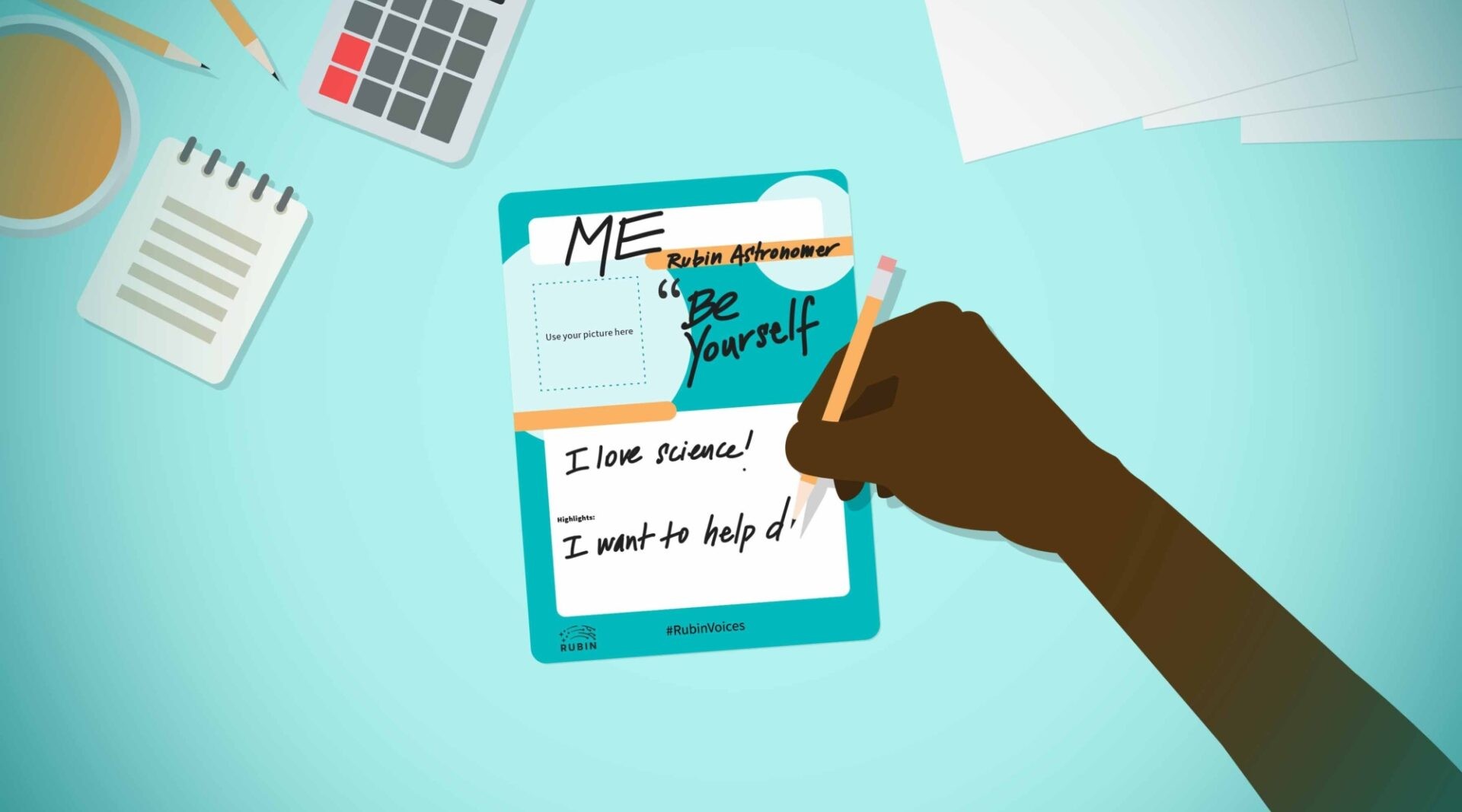
    Rubin Voices Trading Cards are intended to showcase the diversity of people who make the observatory and its science possible. We want our students to see themselves in a STEM/STEAM career as well!

    Here are two customizable templates that students can use to design their own Rubin Voices Trading Card. Please download a copy into your local storage. These may be completed digitally or printed.

    pdf version of blank trading card (81.17 kB)
    Google doc version of blank trading card

    Additional Notes

    Guidelines for file types and sizes
    • The best image format for your trading card is a .jpg.
    • An image size of 100 x 100 pixels will work best.
    Free tools for resizing images
    • Mac: Use Preview. Go to the Tools option in the top menu bar, then choose Adjust size.

    • PC: Open the image you want to resize using the Photos app. Click the ellipsis button on the menu bar at the top, then click Resize.

    • Chromebook: Open a photo or video with the Camera app. At the top, select Rescale.

    • Online: Open PixlrE and open your image. Under the page menu, select Smart resize.

    Free pdf readers
    • Adobe Acrobat Reader
    • Foxit Reader
    • Javelin PDF Reader

    Rubin Voices

    Hear from some of the people doing cutting-edge science with Rubin Observatory

    Go to Rubin Voices
    decorative