
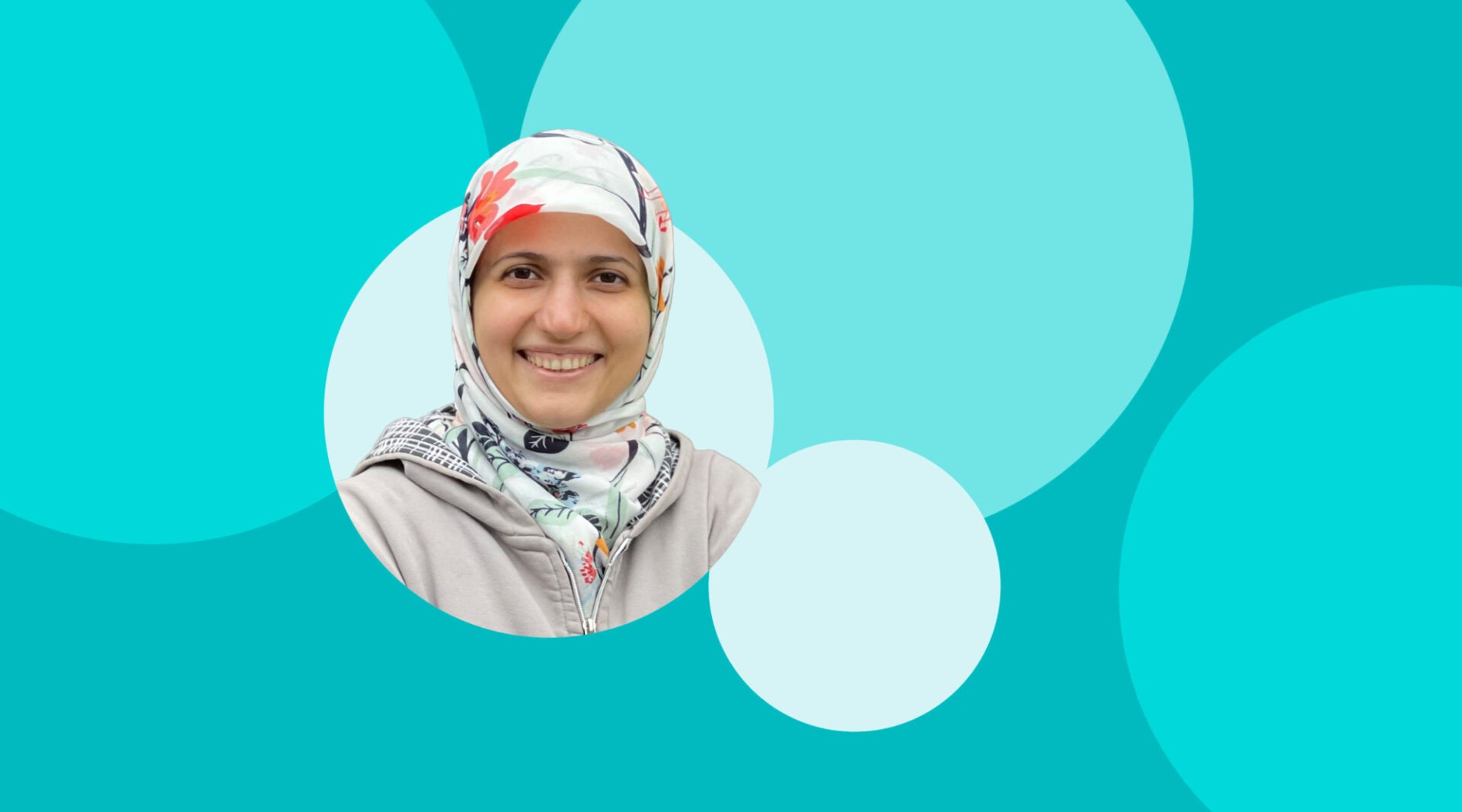
Somayeh Khakpash
ella
Somayeh es una astrofísica que busca los pequeños cambios en las señales de luz que ocurren cuando un objeto masivo pasa frente a un objeto de fondo.
Destacados
- Ha querido ser astrónoma desde que tenía ocho años.
- Es una ávida lectora y cinéfila
- Nació y vivió en Irán hasta sus estudios de posgrado en los EE.UU.
Dr. Somayeh Khakpash has already studied a wide array of astronomy topics in her relatively short career so far. From her initial love for planets to using artificial intelligence to study exploding stars and matter throughout the Universe…you might wonder how one person could study so many things. But they all have a common thread that Someyah has made use of—one we’ll get to later!
Somayeh has wanted to be an astronomer since she was a child in the Middle East. “I was born and raised in Iran and when I was eight years old, I fell in love with astronomy because somebody gave me a coloring book about planets.” Soon, Somayeh went from coloring planets to reading all she could about them and other astronomy topics. But it wasn't until her PhD at Lehigh University that she got to study planets professionally. During her degree, she looked for planets around other stars using a technique called microlensing, where the planet causes a tiny increase in a star’s brightness by gravitationally bending a bit more light toward us than we’d otherwise see without that planet.
During her PhD Someyah took part in the LSST-DA Data Science Fellowship, a program that teaches astronomy students essential skills for working with large data sets (like what Rubin Observatory will produce). There, she learned techniques like how to train computers to solve complicated astronomy problems through artificial intelligence. Somayeh has carried those skills beyond her research on planets and into other astronomical realms. Now she’s a newly-minted LSST-DA Catalyst fellow at Rutgers University working with large datasets to study exoplanets, supernovae, and how matter is distributed in the Universe.
But how can one astronomer work on so many different topics? “One of the interesting things about astronomy is that it's mostly about data. So once you get to work with…large volumes of data like simulations…you can easily work on different fields within astronomy,” Somayeh says. The same microlensing effect she used to find exoplanets also lets her map how matter is distributed throughout the Universe. And Somayeh’s exoplanet research involved writing a lot of automated programs to analyze changes in light from stars over time, which naturally led to analyzing the changing light from exploding stars, i.e., supernovae. So, the common thread for all of these topics is searching a huge amount of data for small and changing signals, with some artificial intelligence thrown in! Rubin’s Legacy Survey of Space and Time will be just that—a huge dataset full of small signals ready to be pulled out and discovered.
Somayeh is especially excited to see what pattern Rubin scientists will decide on for imaging the sky, called the survey cadence. That decision work has been happening for years and involves hundreds of scientists (including Somayeh). It’s still in progress, but Somayeh marvels at how far it’s come: “It really seemed impossible to have all these different teams agree on something. It's nice to see how a lot of people are working together, and it's really progressing.”
When she’s not thinking about data analysis or survey cadences, Someyah spends most of her free time with her kids: exploring nature, crafting, or pretend-playing. “When I was a kid I did a lot of pretend-playing, so I'm an expert and they love it,” she laughs. Otherwise, you’ll probably find her watching a movie or reading a book, or making connections over a shared love of Harry Potter.
In reflecting on where her life has taken her so far, Somayeh recounted part of a poem by Rumi, a thirteenth-century Persian poet:
You are a treasure, if the gems are your aim
….
Whatever you pursued, is what you became.
“Whatever you're doing, whatever you're trying to achieve is who you will become in the future,” she says, reminding us all to stay true to who we are and to follow our passions—wherever they lead us.
Lightning round Q&A: Get to know Somayeh better!
If you could live in any fictional universe, which one would it be?
I wish there was a Harry Potter world I could live in.
What animal would you swap places with for a day?
An eagle. I would love to experience flying and the eagle is so confident.
What's your favorite season?
I used to be in love with fall, but then I fell in love with winter because I like the snow, but then I changed my mind because I saw too much snow and then I fell in love with the summer.
If you could have lunch with anybody living or not, who would it be?
I would love to have lunch with people that I know and I love!
What is your most used emoji?
😊 the smile with blushed cheeks