Página principal
Localizar el contenido del sitio
    • Acerca de
    • Historia
    • ¿Quién era Vera Rubin?
    • Actualizaciones de la construcción
    • Cultura de Rubin
      • Rubin en Chile
      • Cerro Pachón
      • Selección del emplazamiento del observatorio
      • Organización del observatorio
      • Liderazgo
      • Colaboraciones científicas
    • Información de financiamiento
      • Trabaje con nosotros
      • Trabajos
    • Información de contacto
    • Explore
    • Rubin Basics
      • Cómo funciona Rubin
      • Investigación del Espacio-Tiempo como Legado para la Posteridad (LSST)
      • Tecnología de Rubin
      • Flujo de alertas
      • Rubin en cifras
    • Objetivos científicos
    • Voces de Rubin
    • Involúcrate en la investigación de Rubin
      • Actividades, juegos y más
      • Juego Space Surveyors
      • ¡Crea tu propia Carta Coleccionable de Voces de Rubin!
      • Serie de videos animados
    • Galería
      • Main Gallery
      • Test gallery
      • Graphics and Illustrations
      • Canto webhooks test
    • Presentaciones de Diapositivas
    • Webcam de la cumbre
    • Planetarium Assets
    • Construction Archive Gallery
    • Media Use Policy
    • Noticias
    • Comunicados de Prensa
    • Para los medios
    • Comunicados de Prensa
    • Para los científicos
      • Rubin 101: survey, camera, and telescope
      • LSST Science Camera
      • Telescopes
    • Ciencia ciudadana
    • Draft Sub-Pages For Scientists
    • Educación
    • Preguntas frecuentes - Educación
    • Educadores
    • Glosario
    • Investigaciones
    • Calendario
  • Simonyi Telescope
    • First Look
    • Large FOV Image
    • Large FOV Image
    • Time Domain Product 1
    • Time Domain Product 2
    • The Beauties
Localize site content

Conecta con nosotros

  • Visite el Observatorio Rubin en Facebook
  • Visite el Observatorio Rubin en Instagram
  • Visite el Observatorio Rubin en LinkedIn
  • Visite el Observatorio Rubin en Twitter
  • Visite el Observatorio Rubin en YouTube
  • Contáctenos
  • Trabaja con nosotros
  • Intranet (en inglés)
  • Guía de identidad visual (en inglés)
  • Galería
  • Política de privacidad

La Fundación Nacional de Ciencias (NSF) y la Oficina de Ciencias del Departamento de Energía (DOE) apoyarán al Observatorio Rubin en su fase de operaciones para conducir la Investigación del Espacio-Tiempo como Legado para la Posteridad. También apoyarán la investigación científica con los datos. Durante sus operaciones, el financiamiento de la NSF lo administra la Asociación de Universidades para la Investigación en Astronomía (AURA, por su sigla en inglés) bajo un acuerdo colaborativo con la NSF, y el financiamiento del DOE lo administra Laboratorio Nacional de Aceleradores SLAC (SLAC, por su sigla en inglés), bajo un contrato con el DOE. El Observatorio Rubin es operado por el Laboratorio Nacional de Investigación para la Astronomía Óptica-Infrarroja de la NSF (NOIRLab) y por el SLAC.

La NSF es una agencia independiente creada por el Congreso de los Estados Unidos en 1950 para promover el progreso de la ciencia. La NSF apoya la investigación básica y las personas para crear conocimiento que contribuya a la transformación del futuro.

La oficina de Ciencias de DOE es la mayor fuente de financiamiento de la investigación básica en ciencias físicas en los Estados Unidos y está trabajando para hacer frente a algunos de los retos más desafiantes de nuestro tiempo.

  1. Noticias
  2. LSST Primary/tertiary Mirror (M1M3) Leaves Tucson, Bound For Chile
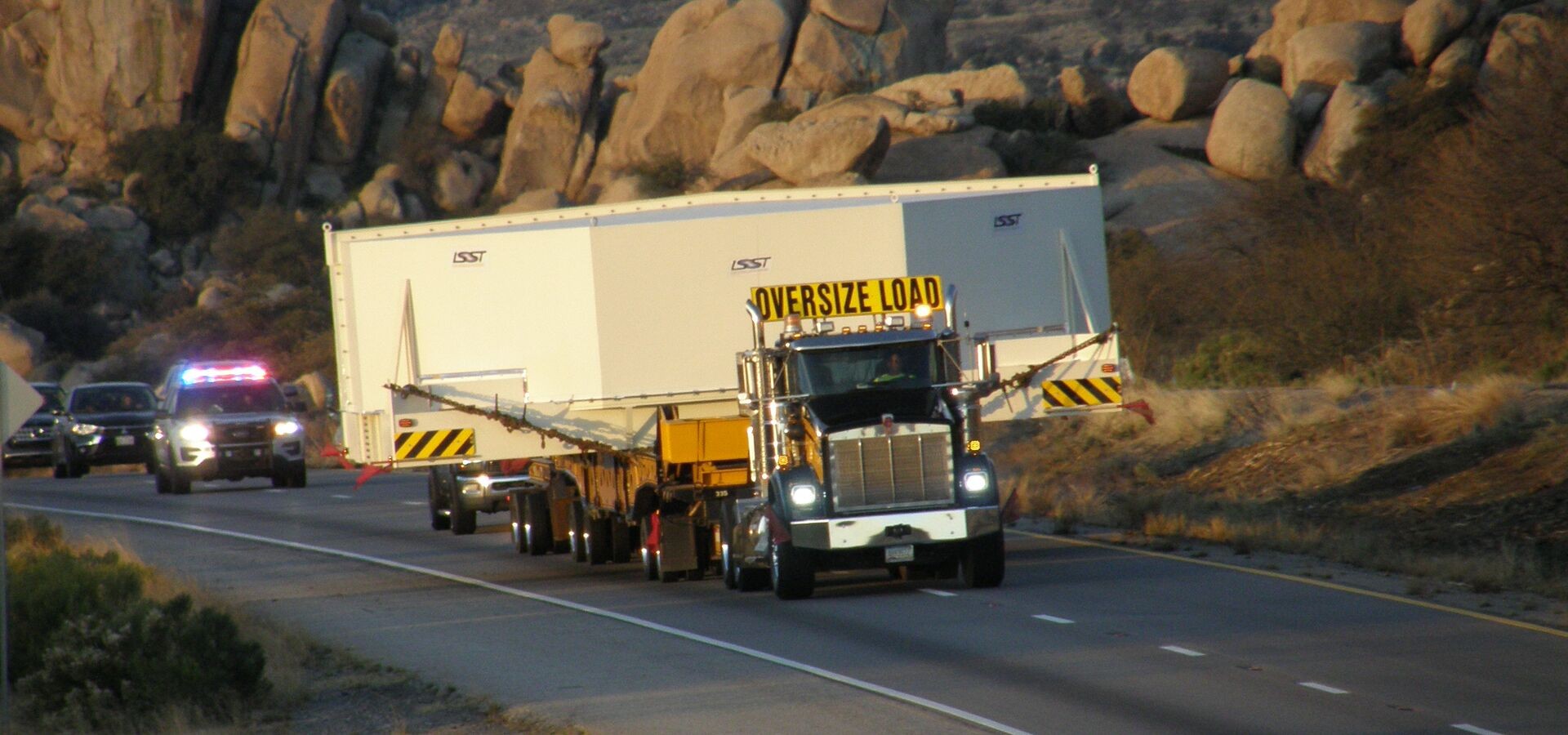
M1M3 Travels from Tucson to Houston

Multimedia

M1M3 Travels from Tucson to Houston

Noticias relacionadas

Cargando las noticias...
Volver a noticias

LSST Primary/tertiary Mirror (M1M3) Leaves Tucson, Bound For Chile

15 de marzo de 2019
The 8.4-meter Primary/Tertiary Mirror (M1M3) for the Large Synoptic Survey Telescope (LSST) has begun its journey from Tucson to north-central Chile, where it will be integrated with the telescope on Cerro Pachón. The M1M3, in its secure storage container, was loaded onto a Precision Heavy Haul, Inc. transport vehicle outside the Richard F. Caris Mirror Lab at The University of Arizona in Tucson early Friday morning. It is now on a 10-day trip to the Port of Houston in Texas, where it will be loaded onto a BBC Chartering ship for a 5-week ocean voyage to Chile.

LSST, currently under construction in Chile, is an integrated system designed to conduct an unprecedented decade-long survey of the optical sky. Featuring an 8.4-meter widefield groundbased telescope, a 3200 megapixel camera, an automated data processing system, and an online public engagement platform, LSST is supported by major funding from the National Science Foundation (NSF), with additional funding by the Department of Energy (DOE) Office of Science, and private funding through the LSST Corporation.

The M1M3 was fabricated at the Richard F. Caris Mirror Lab during the period from 2008-2015 thanks to private donations, primarily from Charles and Lisa Simonyi and Bill Gates, before AURA was awarded LSST Construction funding. The mirror was then stored in a hangar near Tucson International Airport until October 2018, when it was returned to the Mirror Lab for further optical testing with new support hardware built at CAID Industries in Tucson. 

Tucker Booth, LSST Telescope and Site Mechanical Engineer, supervised the departure of the M1M3 on Friday morning. Booth remarked, “A lot of people worked very hard to get to this moment. It’s exciting to have the work in Tucson finished, and to move on to the next phase.”

Edward Ajhar, the NSF Program Manager for LSST, commented, “NSF is pleased to hear that this essential and recognizable element of the telescope is officially headed to Chile. LSST will provide huge benefits not just for the astronomical community, but for the general public as well.”

Información Adicional

About LSST

LSST’s mission is to build a well-understood system that provides a vast astronomical data set for unprecedented discovery of the deep and dynamic Universe. LSST seeks to enable science in four main areas: understanding dark matter and dark energy, cataloging the Solar System, exploring the changing sky, and investigating the formation and structure of the Milky Way. LSST is scheduled to begin operations in 2022. More information can be found at www.lsst.org

Financial support for LSST comes from the National Science Foundation (NSF) through Cooperative Agreement No. 1258333, the Department of Energy (DOE) Office of Science under Contract No. DE-AC02-76SF00515, and private funding raised by the LSST Corporation. The NSFfunded LSST Project Office for construction was established as an operating center under management of the Association of Universities for Research in Astronomy (AURA). The DOEfunded effort to build the LSST camera is managed by the SLAC National Accelerator Laboratory (SLAC).

The National Science Foundation (NSF) is an independent federal agency created by Congress in 1950 to promote the progress of science. NSF supports basic research and people to create knowledge that transforms the future.

About AURA

The Association of Universities for Research in Astronomy (AURA) is an international consortium of universities and non-profit institutions that operate world-class astronomy facilities. In Chile, it administers and operates the telescopes of Cerro Tololo, Gemini South, SOAR, and in the future LSST, under a cooperative agreement with the National Science Foundation of the United States.

Obtenga más información sobre este boletín en NOIRlab.edu

Links

Contactos

  • Ranpal Gill
    LSST Communications Manager
    rgill@lsst.org